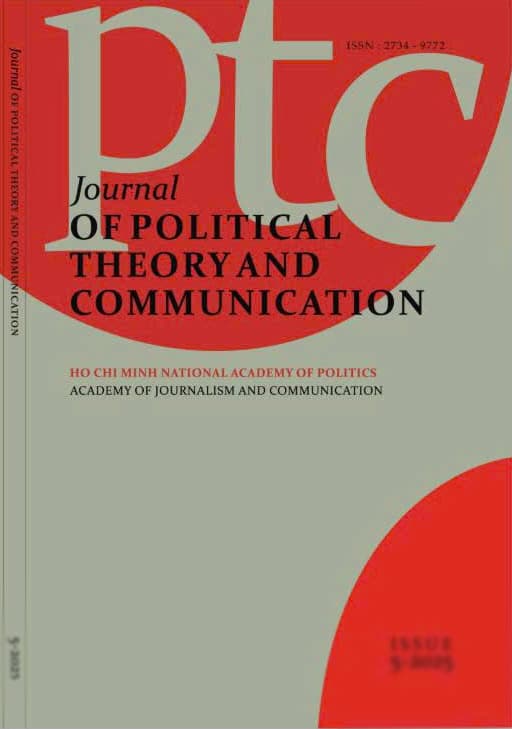
Journal of Political Theory and Communication
Online ISSN: 2734-9780
Print ISSN: 2734-9764
Tạp chí in tiếng Anh - Số 2 (Tháng 10) năm 2025
Journal of Political Theory and Communication

Tạp chí in tiếng Anh - Số 2 (Tháng 10) năm 2025

Vol 31 · No 2 · Year 2025Published: Oct 15, 2025

Review Article

By Thi Thao LE|28, October 2025

The Humane, Humanitarian and Progressive Values in Hồ Chí Minh Thought on Journalism

Hồ Chí Minh’s writing career aimed at gaining national independence and socialism, striving for freedom and happiness of the Vietnamese people, building a revolutionary press for the people and by the people. The article focuses on the values in Hồ Chí Minh Thought on journalism, namely the humane, humanitarian, and progressive values which are considered a unique feature and play an orienting role in the current revolutionary press.

DOI: 10.66057/j6w36m03
By Duc Hoang LE|28, October 2025

Firmly Safeguarding the Party’s Ideological Foundation, Advancing into the Era of National Rise

The choice of the Marxist–Leninist path of socialist revolution is the choice made by the history of the Vietnamese nation itself. Following this path, under the leadership of the Communist Party of Vietnam, the Vietnamese people overcame every difficulty and challenge, achieved great victories, and ushered in many new epochs of qualitative development. Therefore, in all circumstances, the entire Party, the entire military, and the entire people are united and determined to firmly safeguard the Party’s ideological foundation as the guiding principle for action, as we advance into the nation’s era of ascent and strive for new triumphs.

DOI: 10.66057/9emxh858

Short Communication

By Cheng Enfu, Lu Chunyi|29, October 2026

Research on the Mechanism of Dollarization and De-dollarization under the Global Financialization System (Part 2)

Based on Marxist monetary theory, this paper investigates the formation mechanism of dollarization, its real-world impacts, and corresponding countermeasures. From a financialization perspective, the internationally dominated monetary system by the U.S. dollar has undergone three stages: the gold- dollar system, the oil-dollar system, and the institution-dollar system. Among them, the institution- dollar system, also known as the global financialization system, is a fusion of commodity and financial markets, domestic and international markets, achieved through financialization under the neoliberal institutional framework. It has further promoted the expansion of the U.S. dollar’s international monetary power. The expansion of international monetary power is primarily achieved through dollarization, and global dollarization is realized through three financialization mechanisms: commodity financialization, technological financialization, and institutional financialization. Commodity financialization serves as the foundation for global dollarization, technological financialization acts as the catalyst, and institutional financialization provides the fundamental guarantee for global dollarization. Dollarization, centered around U.S. interests, has serious consequences for peripheral countries. The peripheral countries can counter dollarization by promoting international monetary diversification, curbing technological financialization, and fully recognizing the risks associated with neoliberal reforms: liberalization, privatization, and marketization (LPM). China should prioritize the management of its financial strength and adopt high-quality economic development and Renminbi internationalization as core strategies to advance de-dollarization.

DOI: 10.66057/kzgwr759
By Thi Minh Tuyet TRAN|28, October 2025

Clarifying the Scientific, Revolutionary, and Humanistic Nature of Ho Chi Minh Thought - A Vital Weapon to Protect the Party’s Ideological Foundation and Confront Hostile Viewpoints

President Hồ Chí Minh has entered the “realm of the virtuous,” yet the spiritual legacy he left behind - especially his thought, as its core - continues to demonstrate enduring vitality and illuminating value. The essential foundation of this enduring power and profound value lies in the scientific, revolutionary, and humanistic characteristics of his thought. Systematizing and clearly defining these noble characteristics is an imperative task. The reason is simple: to defend Hồ Chí Minh Thought or to refute distorted interpretations of it - as an inseparable component of the Party’s ideological foundation - one must hold scientific conviction and a thorough understanding of what is being defended. The author has chosen this topic based on that perspective.

DOI: 10.66057/yer7vd79
By Thi Thuy Binh LE|28, October 2025

Hồ Chí Minh’s Views on Target Audience of the Revolutionary Press

On discussing revolutionary press, the first question that journalist Hồ Chí Minh was concerned about was “to whom does he write for?”, that is, to find the target of revolutionary journalism’s reflection and service, because this answer determines the entire purpose, content and form of writing, as well as the qualities and ethics of journalists. Hồ Chí Minh was always consistent in his viewpoint: revolutionary press must aim to serve the general public; at the same time, each newspaper has its own target of service. The popularity and the specificity of journalism are not opposed or contradictory to each other, but they harmoniously combine and complement to each other, creating a unique characteristic in Hồ Chí Minh’s viewpoint on the target audience of the revolutionary press.

DOI: 10.66057/7p6jkv97